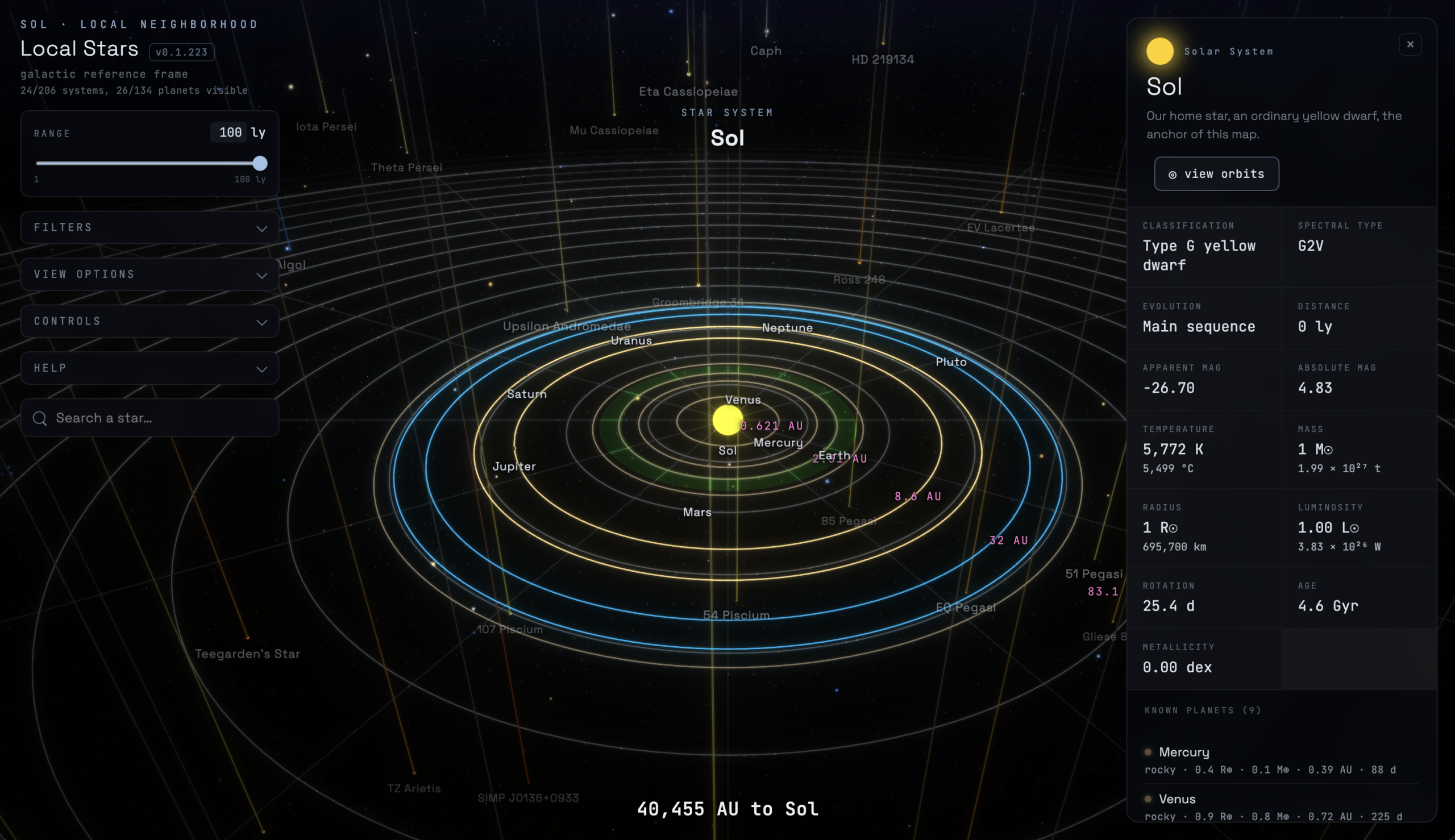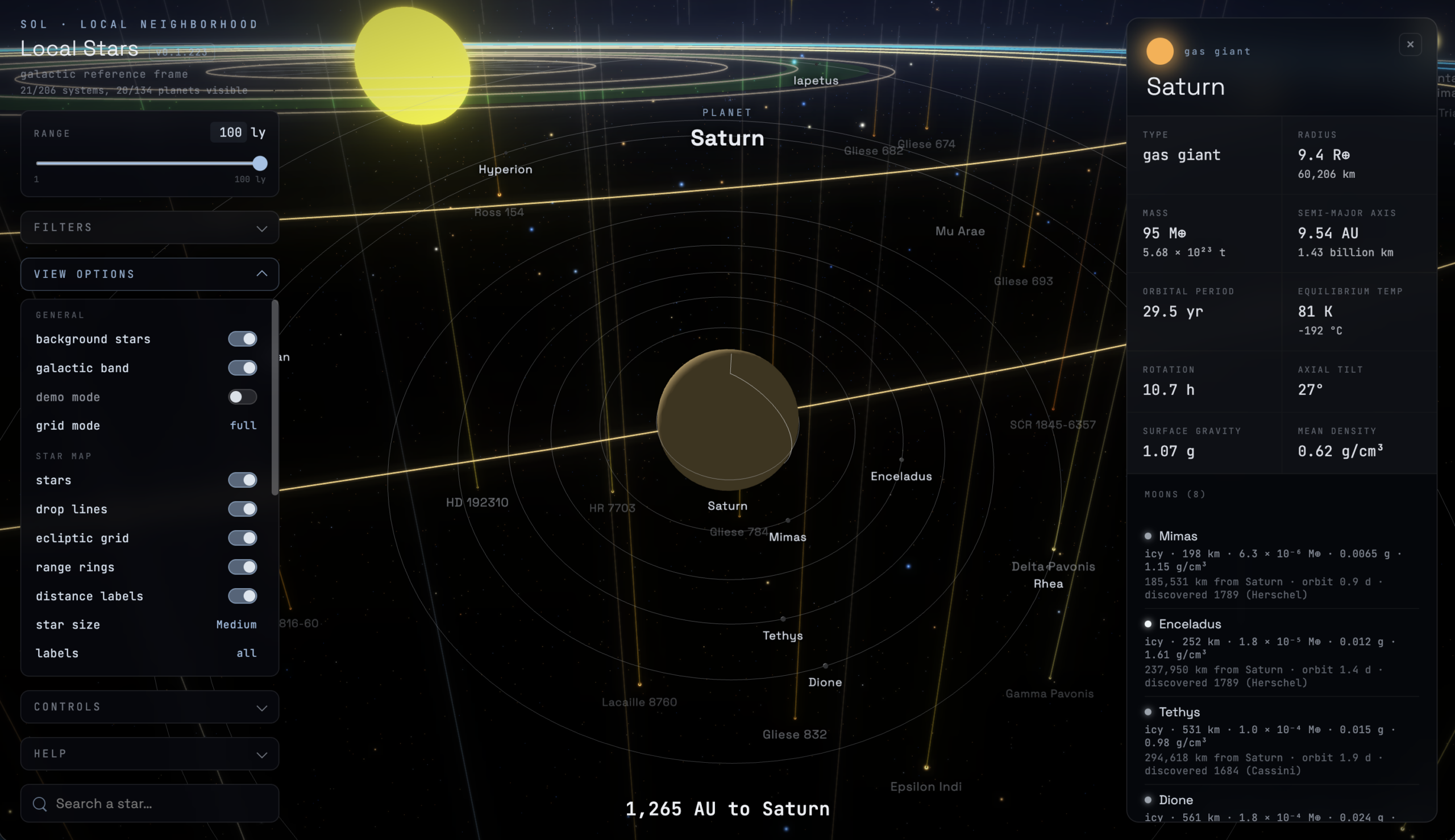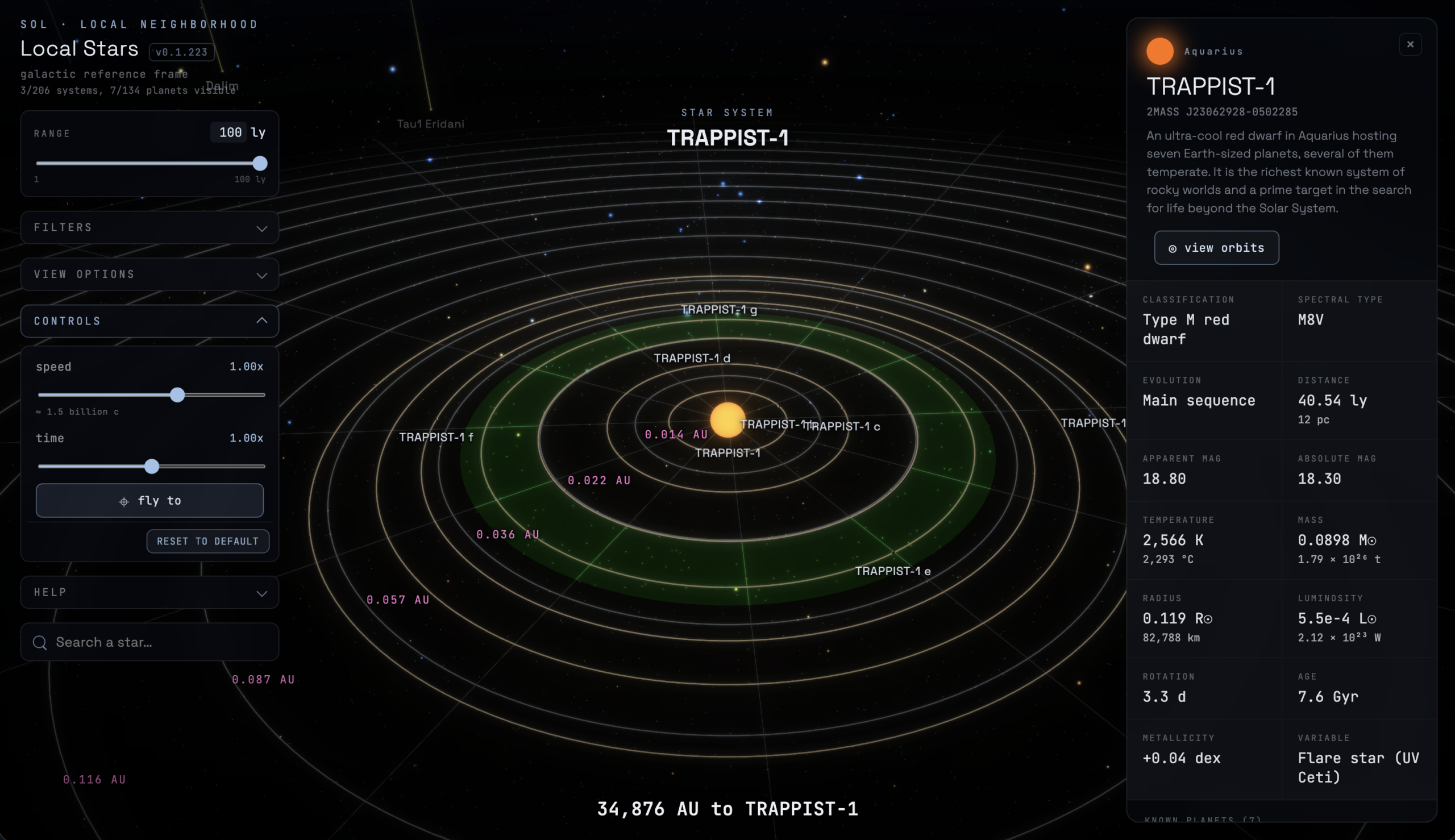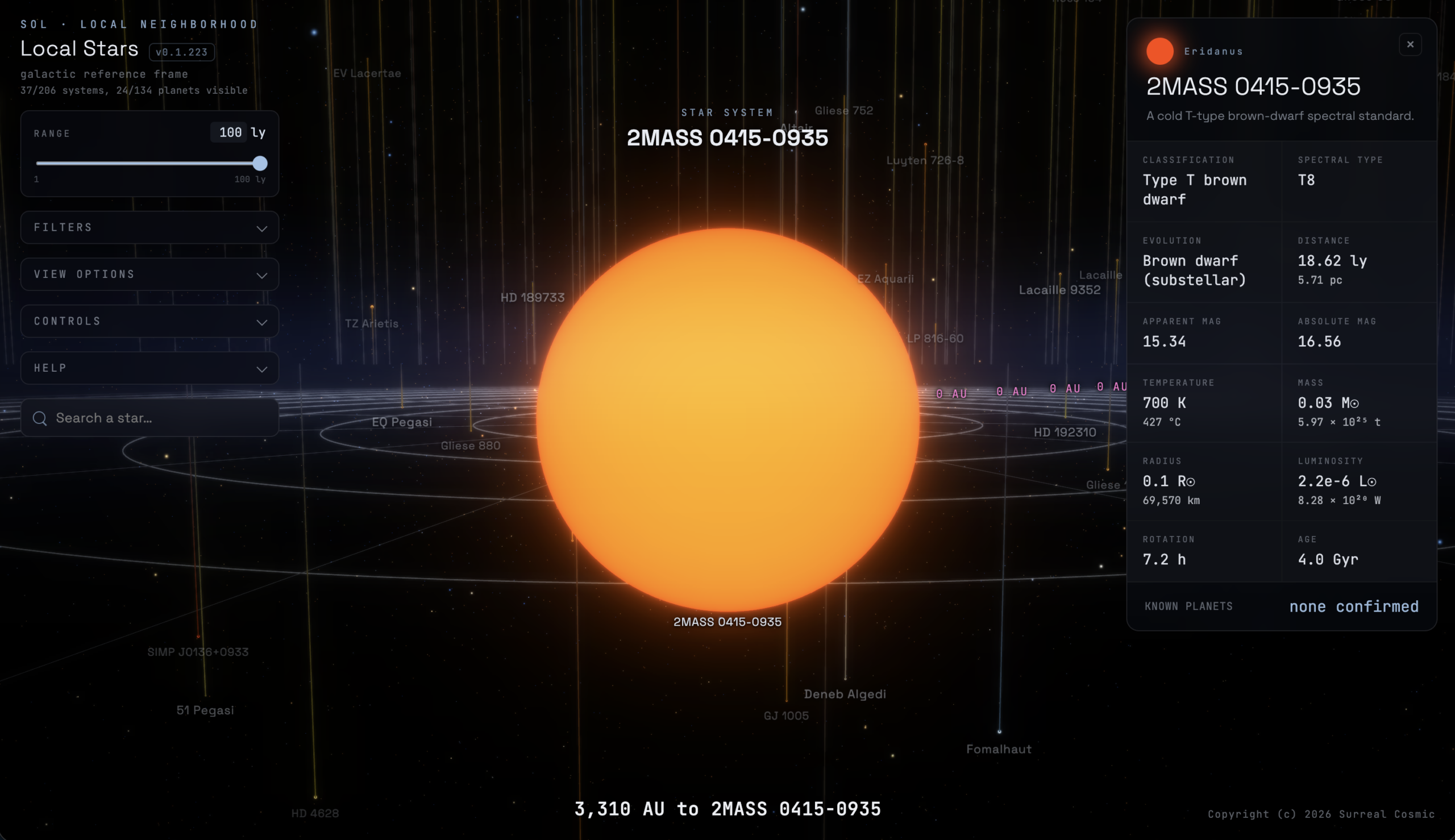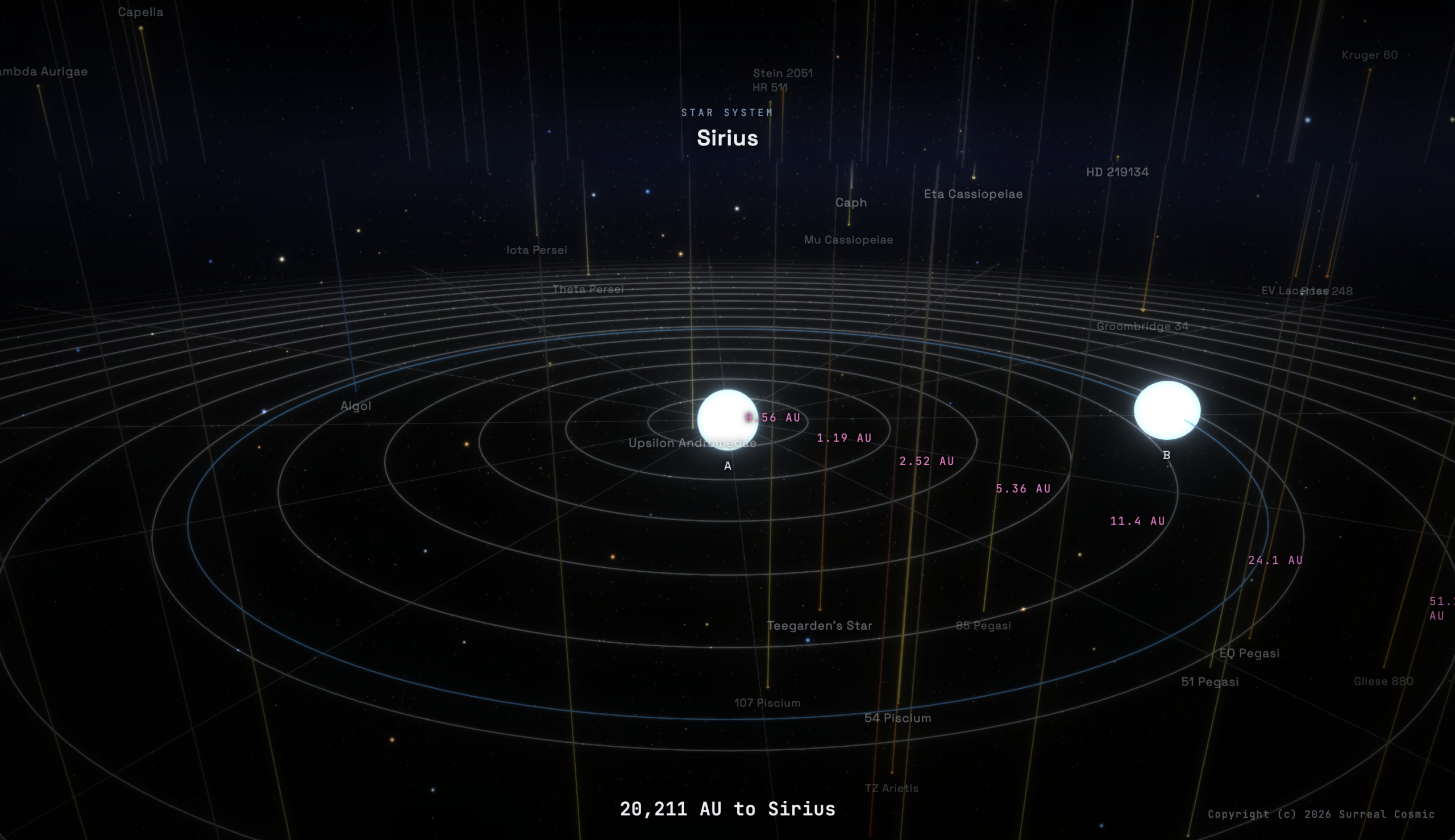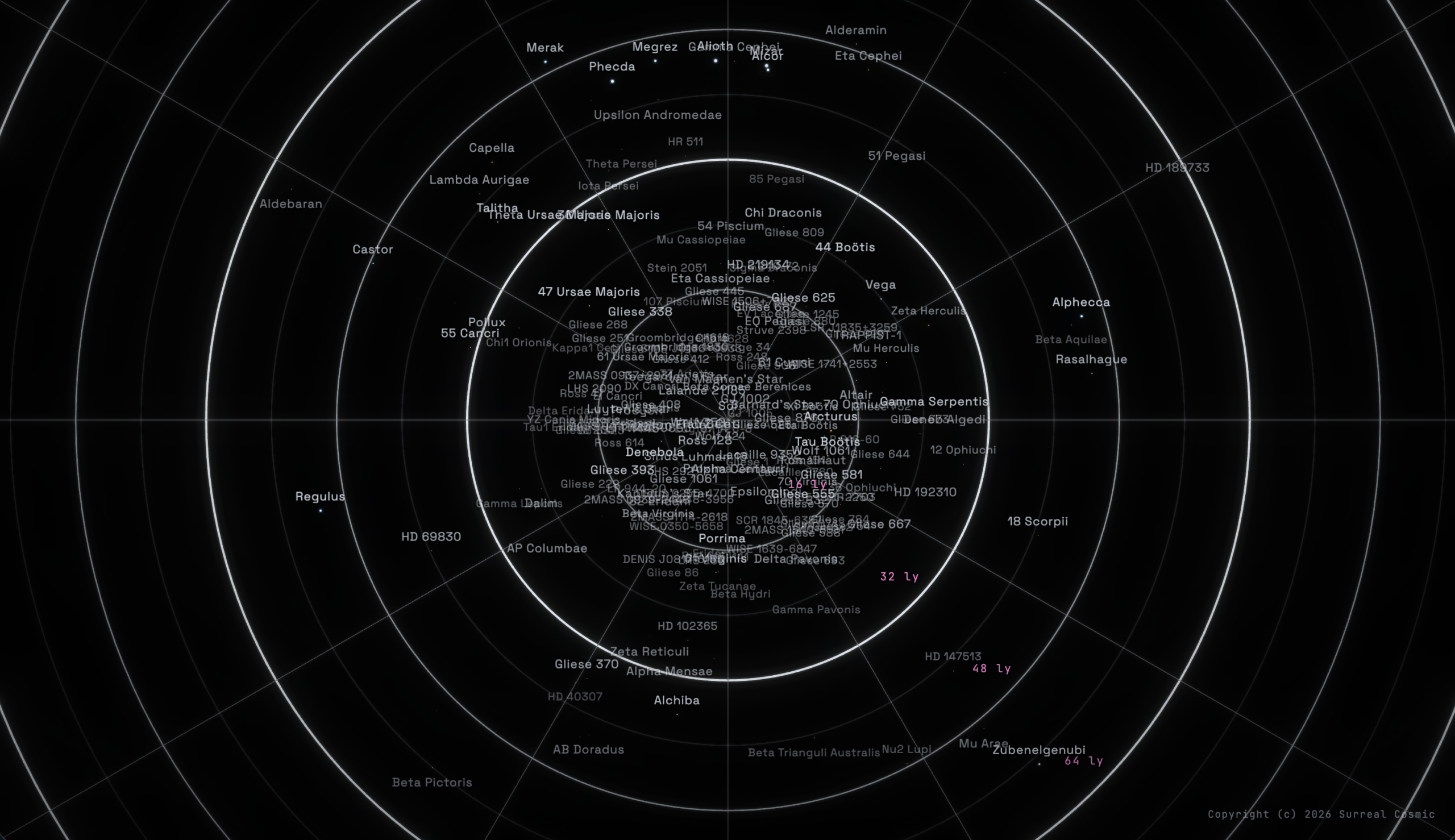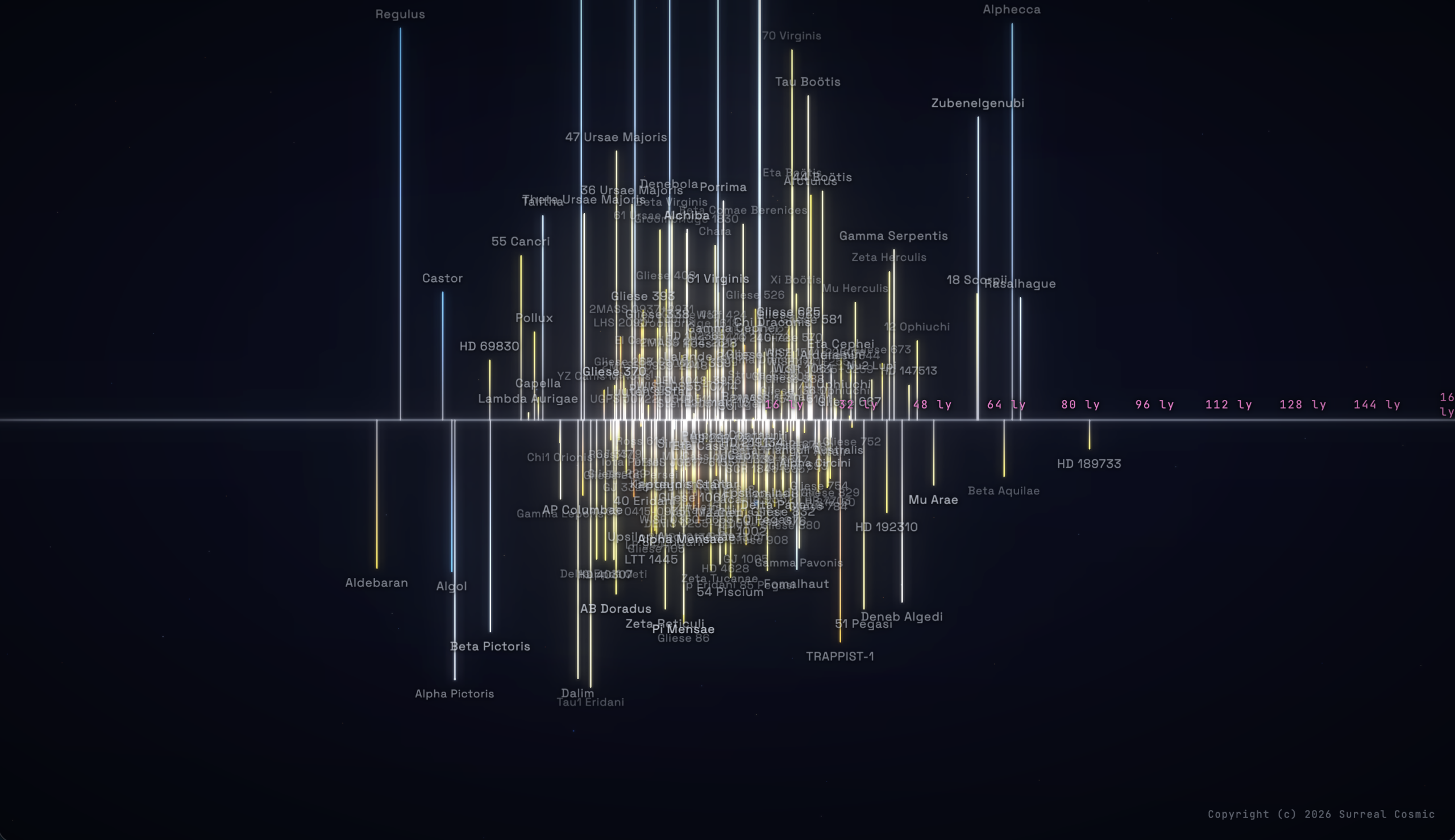
The Local Stars starmap is an interactive 3D map presenting the local stellar neighborhood around the Solar System with a maximum range of 100 light years.

The map uses an ecliptic plane grid with the Solar System at its center and droplines for stars sitting above or below the plane. You can select any of the local stars and dive into its system view by pressing F. There’s also a plethora of view options, filtering options, search, and a help panel with all the useful keyboard shortcuts available.
Notably, the map supports two different grid modes: Simple and Full. The Full mode uses a more advanced grid that increases in resolution as you zoom in and recenters itself on any focused star, while the Simple mode remains fixed on the Solar System and provides a more traditional point of reference.
Check out the map at starmap.surrealcosmic.com!
The original idea was fairly straightforward. I wanted a way to visualize nearby stars on an ecliptic plane similar like these stone-old but aesthetic atlasoftheuniverse diagrams and explore them in 3D from perspectives that aren’t possible with traditional star charts. Moving in an empty space with stars thrown in gives you something but still leads to utter disorientation, but actually seeing the stars aligned above or below a reference plane can help a lot in understanding the spacial relation between them.
This started as a weekend project but within a week more features found their way in. Star system views were added, more exoplanets, more view options, filter options, search capability, data visualization options, better navigation, etc. Eventually the project became less of a simple visualization and more of a production-grade interactive exploration tool for our local corner of the galaxy.
One thing that quickly becomes apparent while using the map is how deceptive the night sky can be. Stars that appear close together from Earth’s perspective may be separated by dozens of light years, while stars that look unrelated can turn out to be near neighbors in three-dimensional space. Exploring the map often reveals relationships and structures that are difficult to appreciate from conventional astronomical diagrams.
The data focuses on stars within approximately one hundred light years of the Solar System, encompassing many of the stellar systems most likely to be familiar to astronomy enthusiasts, science-fiction writers, worldbuilders, and curious explorers alike. You can freely move through the region, investigate individual systems, and get a better sense of the cosmic neighborhood. Note that the map is not exhaustive – in reality there are many more stars within this space range.